


Drop Zone Borneo - The Raf Campaign 1963-65
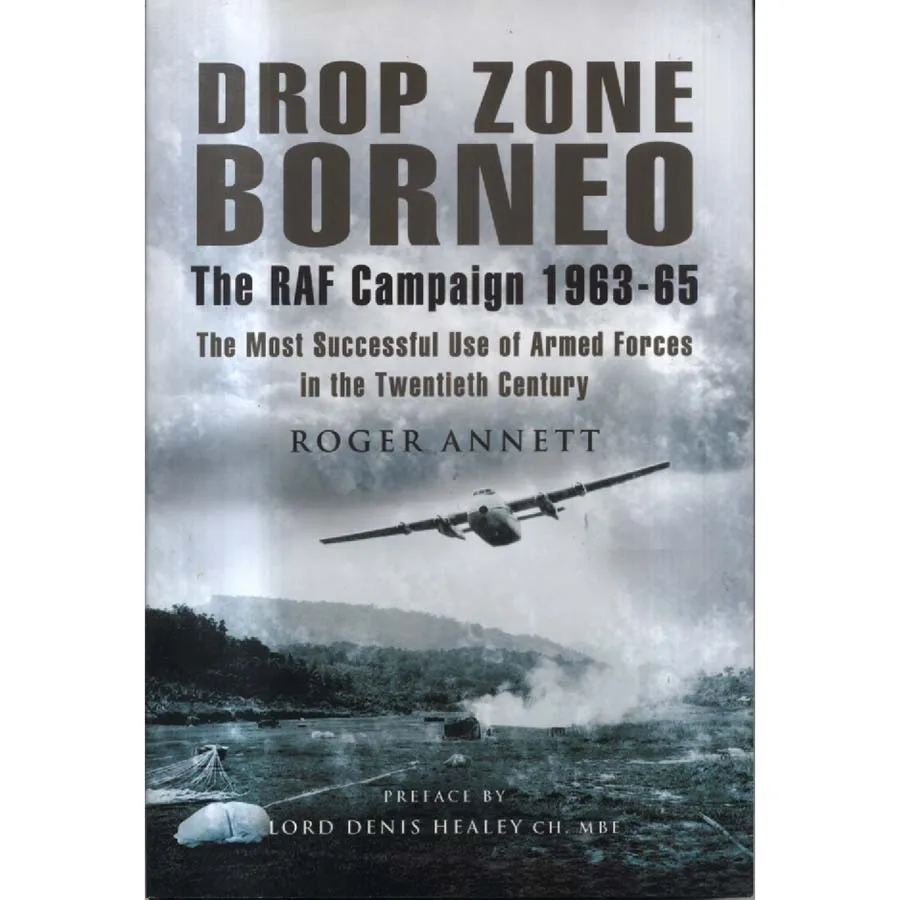
Publisher: Pen and Sword
Format: Hardback
ISBN: 9781844153961
Drop Zone Borneo – The RAF Campaign 1963–65 (2006) by Roger Annett
Pen and Sword | ISBN: 9781844153961 | Condition: Very Good
There are wars that dominate history books, wars that produce thousands of documentaries, and wars that are remembered principally by the unfortunate people who actually had to fight them. Then there is the Indonesian Confrontation of the 1960s, a peculiar and frequently overlooked conflict in which British and Commonwealth forces spent several years conducting military operations in some of the most inhospitable jungle terrain on Earth, while the wider world remained considerably more interested in events taking place elsewhere. In Drop Zone Borneo – The RAF Campaign 1963–65, Roger Annett recounts the extraordinary contribution of the Royal Air Force to this remarkable campaign, providing a fascinating firsthand account of a conflict in which the ability to deliver supplies to the correct patch of jungle could prove considerably more important than possessing the most impressive collection of military hardware.
The Indonesian Confrontation, sometimes referred to simply as Konfrontasi, developed from Indonesia’s opposition to the formation of Malaysia in 1963. President Sukarno’s government regarded the new federation with considerable hostility, and the resulting tensions escalated into a prolonged campaign of infiltration, border clashes and military operations across Borneo and the surrounding region.
For Britain, the situation presented an exceptionally awkward problem. Having spent much of the preceding decades withdrawing from various imperial commitments, the country now found itself responsible for helping defend territories in a remote corner of Southeast Asia against an opponent possessing substantial military resources and considerable enthusiasm for making everybody’s life difficult.
The terrain was hardly ideal for conventional warfare. Borneo offered dense tropical jungle, mountainous country, formidable rivers, unpredictable weather and an impressive selection of obstacles to anyone attempting to move soldiers or supplies across the landscape. Roads were often absent, communications were difficult and the distance between isolated military positions could transform an apparently straightforward journey into a major logistical expedition.
In such circumstances, the Royal Air Force became indispensable.
Roger Annett was particularly well qualified to describe the experience, having served as a co-pilot with No. 215 Squadron, flying Armstrong Whitworth Argosy transport aircraft during the campaign. His account draws upon the practical realities of operating military transports in a region where the weather could change rapidly, the terrain offered little room for error and the successful delivery of essential supplies was a matter of genuine operational importance.
The Argosy was a remarkable aircraft, possessing a distinctive twin-boom configuration and a substantial cargo capacity that made it particularly useful for military transport operations. It was not a glamorous fighter aircraft designed to engage enemy machines in spectacular aerial combat, nor a sleek strategic bomber intended to inspire awe through its appearance. It was, instead, an extraordinarily practical flying delivery vehicle, built to transport men and equipment to places where such things were desperately needed.
And in Borneo, they were needed almost everywhere.
For the soldiers stationed in isolated jungle positions, regular air supply could mean the difference between maintaining operational effectiveness and discovering that an entire military unit was about to run out of food, ammunition, medical equipment or other essentials. Helicopters, transport aircraft and carefully coordinated supply operations became central to the success of the campaign, enabling relatively small ground forces to operate across enormous areas of difficult country.
This was warfare in which logistics did not merely support the fighting; logistics made the fighting possible.
Annett’s experiences with No. 215 Squadron provide an illuminating perspective on this less celebrated side of military aviation. Rather than concentrating exclusively upon dramatic combat encounters, the book examines the demanding routine of flying supplies into a hostile operational environment, where navigation, aircraft handling, weather conditions and the accuracy of a drop could all have serious consequences.
There is something wonderfully ironic about the military profession’s tendency to celebrate spectacular acts of destruction while paying rather less attention to the people responsible for ensuring that everybody has sufficient fuel, food and ammunition to continue operating.
A fighter pilot who shoots down an enemy aircraft may become a national hero. A transport pilot who successfully delivers several tons of desperately needed supplies into a remote jungle clearing is considerably less likely to receive a starring role in a cinema production, despite the fact that his contribution may be just as important to the outcome of the campaign.
Indeed, the whole operation could be regarded as an enormous exercise in overcoming geography.
The jungle was not merely a backdrop to the conflict. It was an active obstacle, making movement difficult, complicating communications and placing extraordinary demands upon both soldiers and aircrew. Tropical weather could create sudden difficulties, while the mountainous terrain and limited facilities required careful planning and considerable flying skill.
For aircrew operating in the region, the challenges extended beyond the ordinary technical demands of military transport. They were flying aircraft heavily involved in supporting an active campaign, frequently under circumstances where the margin for error was uncomfortably narrow.
The Argosy’s ability to carry substantial quantities of cargo was an enormous advantage, but getting those supplies to the people who needed them required skill, coordination and reliable information about conditions on the ground.
After all, there is little practical benefit in successfully transporting several tons of essential equipment across hundreds of miles if it ultimately lands in a patch of jungle occupied by nobody except insects, snakes and individuals whose political sympathies are decidedly inconvenient.
One of the remarkable aspects of the Borneo campaign was the relatively small size of the forces defending the Malaysian territories compared with the military resources potentially available to Indonesia. In 1963, the Indonesian Army numbered approximately 330,000 men, with substantial formations deployed within reach of the Borneo frontier.
The campaign consequently demanded an imaginative approach to military operations. British and allied forces relied upon intelligence, mobility, specialist jungle training and the ability to sustain isolated positions rather than attempting to match the opposing forces through sheer numbers.
From 1964, British and Commonwealth troops also conducted secret cross-border operations into Indonesian territory under the codename Claret, applying pressure to enemy forces while attempting to prevent the conflict from escalating into a wider war.
The combination of carefully controlled ground operations and effective logistical support contributed to a campaign whose eventual outcome has often been regarded as an outstanding example of limited military force employed to achieve defined political objectives.
There is a lesson here that military planners have not always found convenient to remember: sometimes the most successful campaign is one that achieves its objectives without becoming an enormous and expensive international catastrophe.
The success of the transport operations was itself extraordinary. Throughout the Borneo campaign, the RAF’s supply-dropping transport aircraft suffered no fatalities, a remarkable achievement given the demanding terrain, weather and operational conditions.
That record speaks volumes about the professionalism of the personnel involved, although one suspects that the aircrew themselves would have been more inclined to discuss the practical challenges of flying than deliver elaborate speeches concerning their contribution to the glorious history of military aviation.
British servicemen have traditionally displayed an admirable ability to confront alarming circumstances with understatement, particularly when the alternative involves admitting that something was absolutely terrifying.
The contrast between Borneo and the much more extensively documented Vietnam War is especially striking. While American military operations in Vietnam attracted enormous international attention, the Indonesian Confrontation unfolded with comparatively little publicity.
The fighting in Borneo received only a fraction of the coverage devoted to the escalating conflict elsewhere in Southeast Asia, despite involving significant strategic interests and demanding considerable military effort.
This comparative obscurity has continued to affect the campaign’s place in popular history. Ask most people to identify a major conflict of the mid-1960s and they will probably mention Vietnam. Ask them about the RAF’s transport operations in Borneo and they may assume that the subject concerns a particularly demanding package holiday.
Yet the campaign offers an important example of the relationship between political objectives, military restraint and practical operational capability.
Annett’s book is valuable precisely because it helps bring attention to the individuals who performed the unglamorous but essential tasks upon which the campaign depended. The aircrews, ground personnel and supporting organisations rarely enjoyed the public recognition associated with more spectacular military operations, but their work was fundamental to sustaining the forces defending Malaysia.
There is also the human side of the experience. Military service in the Far East during the 1960s involved unfamiliar environments, separation from home, demanding routines and the sometimes peculiar social world of service life in distant postings.
For a young RAF officer, arriving in Singapore and becoming involved in operations over Borneo must have represented an extraordinary departure from the comparatively predictable circumstances of training establishments in Britain.
The transition from English airfields to the tropical environment of Southeast Asia was not merely a matter of exchanging woollen clothing for something more appropriate to the temperature. It involved adapting to a different climate, different operational conditions and a military campaign whose outcome depended upon the consistent performance of people working far from public attention.
And naturally, there was the weather.
The tropics possess an unfortunate habit of producing conditions that can transform a routine flying operation into an exercise in professional concentration. Heavy rain, cloud, turbulence and rapidly changing visibility are hardly unusual features of equatorial aviation, and the combination of such conditions with mountainous jungle terrain creates an environment in which pilots have excellent reasons to pay considerable attention to what they are doing.
It is one thing to fly across the English countryside, where a suitable emergency landing area may occasionally be identified without too much difficulty. It is quite another to operate over mile after mile of tropical forest, where the landscape offers few attractive alternatives should the machinery suddenly develop an objection to remaining airborne.
The book also serves as an interesting reminder of the practical nature of military aviation before the widespread introduction of the sophisticated navigation and electronic systems available today.
Aircrew relied upon the equipment, procedures and professional training of their period, combining technical knowledge with experience and careful judgement. The business of delivering supplies accurately over remote jungle terrain demanded a level of preparation and coordination that may not always be appreciated by readers accustomed to modern satellite navigation and precision-guided technology.
Of course, even the most sophisticated contemporary equipment cannot entirely eliminate the difficulties presented by an enormous tropical jungle, but it has certainly changed the experience of finding one’s destination.
Annett’s firsthand perspective distinguishes the book from broader histories of the conflict. Rather than offering only the strategic decisions of senior commanders and the political manoeuvrings of governments, it allows readers to appreciate the work of those carrying out the operations themselves.
This is an especially important distinction in military history. Campaigns are often presented as movements of formations across maps, with arrows, dates and carefully selected descriptions of decisive events. The practical reality involves individuals operating aircraft, maintaining equipment, transporting supplies and attempting to fulfil demanding responsibilities under difficult conditions.
The map may show a neat line representing a supply route. For the aircrew, the same line represents hours of preparation, navigation, flying and the possibility of encountering conditions that the cartographer has rather conveniently omitted.
There is something wonderfully characteristic of British military history in the fact that one of the country’s more successful post-war campaigns remains comparatively obscure. Victories achieved through limited operations, careful planning and sustained logistical effort rarely generate the same popular fascination as disasters involving spectacular misjudgements and enormous casualties.
The public seems to possess an enduring appetite for military catastrophes, perhaps because failure often produces more dramatic stories than the quiet achievement of carefully defined objectives.
Yet the Borneo campaign deserves attention precisely because of the manner in which it was conducted. The successful defence of Malaysia involved a combination of diplomacy, intelligence, ground operations and air support, demonstrating the advantages of coordinating military resources in pursuit of achievable political aims.
That does not mean the campaign was effortless, harmless or free from difficult decisions. Armed conflict is never quite as tidy as it appears in retrospective strategic assessments, and the experiences of those involved were often demanding and dangerous.
Nevertheless, its outcome provides an important contrast with other military interventions of the period.
Published by Pen and Sword in 2006, Drop Zone Borneo is an appealing contribution to the history of post-war British military aviation. The publisher’s established association with military history makes it a natural home for an account of a relatively neglected campaign, particularly one told by an author who actually participated in the operations being described.
It is also a valuable addition to the literature concerning the Armstrong Whitworth Argosy, an aircraft whose important service career has never enjoyed the widespread popular recognition accorded to more glamorous military types.
The Argosy may not have possessed the elegance of a Spitfire or the spectacular performance of a jet fighter, but its role in maintaining essential supply operations gave it a significance that cannot be measured simply through speed, altitude or the number of weapons attached to its airframe.
One might reasonably suggest that the ability to deliver the right supplies to the right people at the right moment is among the most useful achievements of any military aircraft.
Unfortunately, it is also considerably less exciting to describe on a recruiting poster.
For aviation enthusiasts, the book offers an absorbing glimpse into transport operations during a distinctive period of RAF history. For military historians, it provides insight into the practical conduct of the Indonesian Confrontation. For former service personnel and those with family connections to the campaign, it offers a reminder of experiences that deserve a more prominent place in the record of Britain’s post-war military commitments.
There is also something rather appealing about a military memoir concerned with operational competence rather than grandstanding heroics. Annett’s subject is one in which success was often measured by the arrival of supplies, the safe completion of a mission and the continued ability of ground forces to operate in difficult country.
These may not sound particularly romantic achievements, but they are precisely the sort upon which successful military campaigns depend.
This 2006 Pen and Sword edition is offered in Very Good condition by Crappy Old Books, a bookseller that appreciates accounts of overlooked military operations, particularly those involving extraordinary machines, demanding conditions and the determined efforts of people who rarely found themselves featured on the front pages of national newspapers.
Unlike the aircraft described within its pages, this volume requires no runway, ground crew, navigation equipment or carefully calculated cargo manifest. It can be transported safely through the ordinary postal system, although the possibility of occasional delays remains an unfortunate feature of modern logistics.
An excellent addition to any collection of RAF history, British military aviation, the Indonesian Confrontation, Far Eastern campaigns or personal accounts of post-war service life, Drop Zone Borneo – The RAF Campaign 1963–65 will appeal to readers interested in the less familiar military operations of the twentieth century.
A fascinating firsthand account of the RAF’s vital contribution to the Borneo campaign, combining the realities of military transport flying with the story of a difficult and frequently overlooked conflict in which logistical ingenuity helped achieve a remarkable strategic success.
And perhaps the greatest irony of the entire campaign is that while governments, generals and historians have spent decades debating the merits of spectacular military operations, the troops in Borneo were kept fighting by a collection of aircrews whose principal responsibility was to ensure that everybody received their supplies.
Crappy Old Books: preserving the forgotten corners of military history without requiring a jungle survival course, an Argosy transport aircraft or clearance to operate across an international frontier.
And should anyone question whether military transport flying is quite as exciting as operating a fighter aircraft, simply remind them that a fighter pilot may receive the applause, but somebody still has to deliver his fuel, ammunition and breakfast.
Without the transport aircraft, the whole magnificent enterprise would soon become little more than an expensive collection of grounded machinery and increasingly hungry soldiers.
And as any experienced serviceman will confirm, an army deprived of ammunition is in difficulty, but an army deprived of tea may be approaching outright mutiny.
Keep browsing: See more War books Other books by Roger Annett
